Emily (Niess Portrait)

No, the title isn’t a mistake. Let me explain. I have some under used Hasselblad lenses. I know it’s a shame. They just don’t get used and have been idle for a while. My all time favorite lens, the one I’d like if I only could have one lens is the Carl Zeiss 110mm f2.0 FE. I want to use it a lot more than I do of late. This leads me to the heart f the matter.

While on holiday I purchased a Hasselblad to Nikon adapter (Fotodiox) through Amazon UK so I could get more use from the glass I have. This wonderful piece of engineering (Comes complete in a faux velvet bag.) turns my Nikon D800 into a digital Frankenstein of a camera. Big and, rather odd-looking. I was worried about the strain on the lens mount but the combo doesn’t weigh a lot more compared with the 24-70 I have on the body usually. I haven’t seen or felt any problems as yet. The adapter comes with a tripod mount I however have only used the combination handheld.

The Carl Zeiss 110 f2.0 mounted on my D800 via the Fotodiox adapter.

I set up the lens in the onboard database for non-CPU lenses the nearest focal length was 135mm. This helps the camera with light measurement and aperture value. Well it would if there was a mechanical aperture connection between adapter, and body, which there isn’t so I’m not sure if there is a point.

Stop down the lens to meter you have focus confirmation if needed in the viewfinder. And take your shot.

But that’s enough talk. Here is what you get.

Niess Portrait

This is a quick shot I took of my daughter before she went skateboarding.

This has just been converted to black and white with just a little vignette  added. Remember this was handheld.

Alum Bay III

Alum Bay III by Davidap2009
Alum Bay III, a photo by Davidap2009 on Flickr.

The cliffs here are mostly crumbling sand of varying colours. I thought I’d try to bring this out in black and white. Let me know what you think.

Alum Bay II

Alum Bay II by Davidap2009
Alum Bay II, a photo by Davidap2009 on Flickr.

Second in the series.For those interested.
I have darkened the sky to bring out the dramatic light on the sandy cliffs. I had forgotten my polarising filter that day so in Aperture I selected the blue colour in the sky, removed the luminance and added a little saturation in the colour version .I then added the red filter effect using Silver Efex pro 2.

Alum Bay (Isle of Wight)

Alum Bay by Davidap2009
Alum Bay, a photo by Davidap2009 on Flickr.

One of the places I visited on my holidays was the Isle of Wight. Thats that small island you see in the middle of the south coast of England.This viewpoint ,which was packed with people, looks out to the Needles which is that jagged formation to the left. In the distance you can see the mainland.

Helping Hand (Colour)

Helping Hand (Colour) by Davidap2009
Helping Hand (Colour), a photo by Davidap2009 on Flickr.

I like the colour version just as much as the black and white. Although I mostly am a black and white kinda guy I thought I’d share this shop scan with you. I’ve just added the frame.

Helping Hand

Helping Hand by Davidap2009
Helping Hand, a photo by Davidap2009 on Flickr.

It’s about time I got Victor out of the bag. This shot is an end of roll shot after a cycling lesson. Taken in colour with a Carl Zeiss 110mm f2.0.

Patrick

Patrick by Davidap2009
Patrick, a photo by Davidap2009 on Flickr.

It felt good again to use my MP. It was loaded with Fuji Reala . This shot was taken at f1.4 indoors at some ridiculously slow speed . What makes the shot for me is the light on his spectacle frames. I really love shooting film:0)

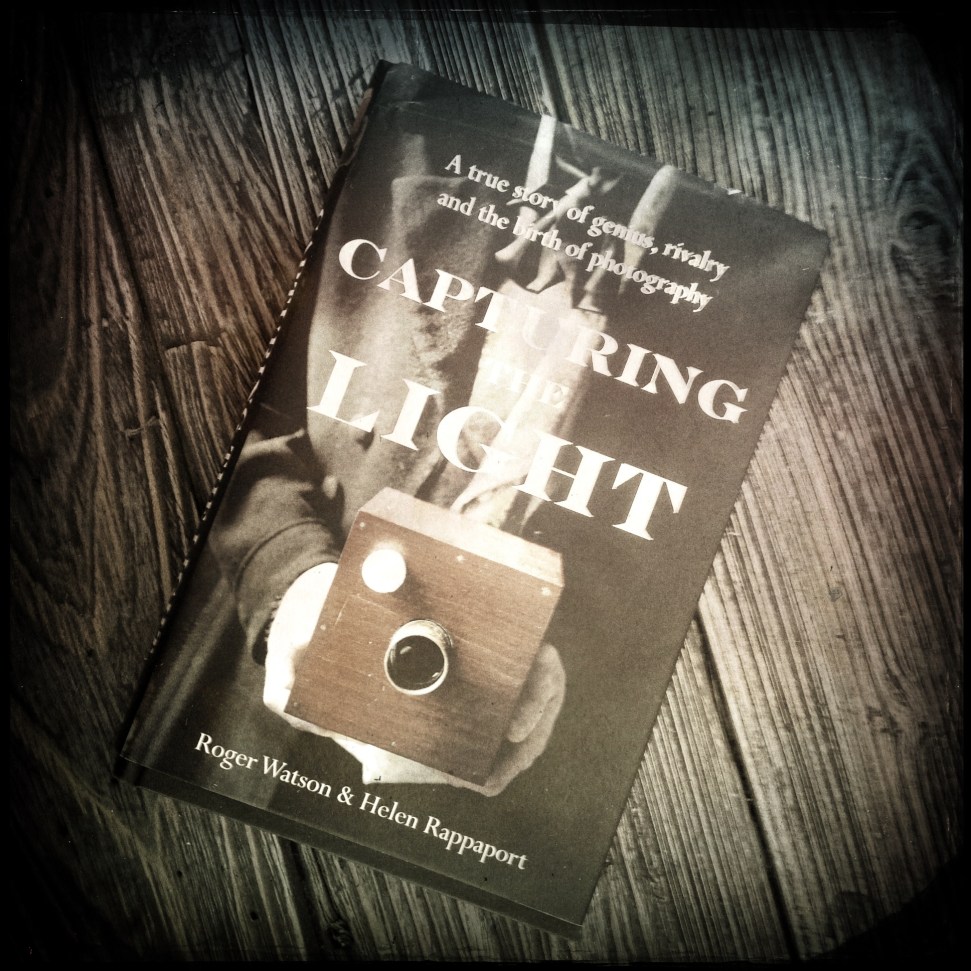
Capturing The Light. A book review.

Capturing the Light  By Roger Watson and Helen Rappaport.

ISBN 978-0-230-76457-6

Published by Pan Macmillan

I haven’t written a book review since I was in school many, many years ago. However since my iMac is in for a screen replacement I’m reduced to blogging on my iPad. So I hope you will bear that in mind while reading this short review.

How was our hobby of photography first invented? How do you capture an image and keep it forever? This is what this book is all about.Capturing the Light is not some dry history book about how and who.It reads much like an adventure story.The authors have done a great job in building the atmosphere of the time and painting a wonderful picture in our minds of the main protagonists in the book namely Louis Daguerre,flamboyant artist, entrepreneur, showman in search of fame and fortune, and Henry Fox-Talbot wealthy gentleman and,humble scientific genius.Both from very different backgrounds, and both with two different methods of working. Daguerre never seemed to make any notes on his work and still today there are doubts about how he discovered his process.

What fascinated me was the length of time it took to find a process to fix an image that did not disappear in sunlight . This major step was what was going to make photography what it is today. Images could be made on paper since the 1790’s but soon disappeared if not viewed by candlelight or moonlight. Then in 1835 Fox-Talbot finds a method and fails to mention it until four years later when, charismatic Louis Daguerre announces his own process to the world. 

I could go on, there is so much in this wonderful book which I would heartily recommend to anyone interested in our hobby.


New Penny Board

My daughter and her New Penny Board. Taken with my iPad and processed with Plastic Bullet software.